
Outdoor Christmas Lights Guide to Types, Hanging, and Safety
Nothing says the holidays have arrived like the first house on the street that switches on its lights. Outdoor Christmas lights turn an ordinary home into something that makes kids point and drivers slow down.
They can also turn a December weekend into a frustrating mess of tangled strands, dead bulbs, and lights that sag off the gutter by Tuesday. The difference usually comes down to choosing the right type of light, planning before you climb, and using the right hardware.
This guide covers all of it. You will learn the main light types and where each one works best, creative outdoor Christmas lighting ideas for every part of your property, how to calculate how many lights you need, a step-by-step method for hanging them, and the safety rules that keep your display, and you, in one piece. We also explain why LEDs have become the standard and what they really save on your electric bill.
Outdoor Christmas Lights for Every Holiday Display
Before choosing bulbs, decide on the overall look you want. That one decision makes every purchase easier.
Classic Warm White Christmas Lights
Warm white is the most popular choice for a reason. It has a soft, golden glow that looks elegant on brick, stone, wood siding, and greenery. It also pairs well with wreaths, garland, and red bows. If you are unsure what to buy, warm white is the safest pick. Cool white bulbs pair especially well with a white Christmas tree glowing in the front window.
Colorful Outdoor Christmas Lights
Multicolor lights feel nostalgic and joyful, especially in classic C9 bulbs. They are a favorite with families and look great on homes with simple white or gray siding. For a more curated look, try a limited mix like red and green, or red, white, and blue-white.
LED Outdoor Christmas Lights
LED outdoor Christmas lights are now the standard. They use far less electricity, run cool, and are usually made with shatter-resistant plastic lenses. Early LEDs looked harsh and bluish, but today’s warm white LEDs closely match the glow of old incandescent bulbs. If you still love the real filament look, our guide to incandescent Christmas lights shows where to buy them and how they compare.
Commercial Outdoor Christmas Lighting
Commercial outdoor Christmas lights are built for years of use on stores, offices, and large homes. They usually have thicker wire, sealed or one-piece bulbs, sturdier sockets, and better waterproofing. Many pros prefer full-wave rectified LEDs, which produce a steadier light with less visible flicker. They cost more, but they last many seasons.
Decorative Christmas Lights for Front Yards
Lighted sculptures, light-wrapped wireframe reindeer, lighted arches, and stake lights fill the yard itself. Use them sparingly. One or two larger lighted pieces near the walk or driveway look more polished than a lawn crowded with small figures.
Best Types of Outdoor Christmas Lights
Each type of light has a job it does best. Matching the light to the spot is the biggest step toward a display that looks professional.
| Light type | What it looks like | Best spots | Skill level |
|---|---|---|---|
| Mini string lights | Small, dense points of light | Trees, shrubs, railings, wreaths | Easy |
| Icicle lights | Strands of varying drop lengths | Gutters and eaves | Easy to moderate |
| C9 bulbs | Large, bold cone bulbs | Rooflines, walkways, big trees | Moderate |
| C7 bulbs | Medium cone bulbs | Porches, small rooflines, railings | Moderate |
| Net lights | A grid of lights on mesh | Hedges and bushes | Very easy |
| Rope lights | Lights inside a flexible tube | Paths, outlines, shapes | Easy |
| Solar lights | Strings with a small solar panel | Garden beds and fences in sunny spots | Very easy |
| Battery lights | Strings with a battery pack | Wreaths, lanterns, mailboxes | Very easy |
| RGB and smart lights | Color-changing bulbs or pixels | Rooflines and trees with app control | Moderate |
| Projectors | Patterns cast onto walls | Facades and garage doors | Very easy |
Outdoor Christmas String Lights
Outdoor Christmas string lights, often called mini lights or fairy lights, are the most versatile option. Use them to wrap tree trunks and branches, outline railings, or weave through garland. Look for wide-angle LED mini lights, which spread light more evenly than older styles, and check the box for an outdoor rating.
Outdoor Icicle Lights
Icicle lights hang down in short strands of different lengths, like frost dripping from the eaves. They look best on long, uninterrupted gutters. For a cleaner look, choose strands with a consistent drop pattern and hang them so the top wire sits tight against the gutter.
C9 Christmas Bulb Lights
C9 Christmas lights are the classic large bulbs seen on rooflines across the country. The “C” refers to the cone shape, and the number refers to the bulb’s diameter in eighths of an inch, so a C9 is about 1 1/8 inches wide. They screw into E17 intermediate sockets, according to The Christmas Light Emporium’s C7 vs. C9 guide.
Most pros buy C9 “stringers,” empty socket wire sold by the foot, then add their own bulbs. Twelve-inch socket spacing is the standard for rooflines. Heavier SPT-2 wire is rated for more current than lighter SPT-1 wire, which matters on long runs. Common commercial spools list SPT-1 at 8 amps and SPT-2 at 10 amps.
C7 Christmas Lights
C7 bulbs are about 7/8 inch wide and use the smaller E12 candelabra base, so C7 and C9 bulbs are not interchangeable. C7s suit smaller homes, porches, railings, and wreaths, where C9s might look oversized.
Outdoor Net Lights
Net lights are a grid of mini lights you drape over bushes like a blanket. They are the fastest way to light hedges evenly. Common sizes are 4 by 6 feet, so measure your shrubs and buy enough to cover the top and the visible sides.
Outdoor Rope Lights
Rope lights are small bulbs inside a flexible, clear plastic tube. They are tough, weather-resistant, and easy to bend into shapes or run along walkways, steps, and fences. They give a continuous line of light rather than separate points.
Solar-Powered Christmas Lights
Solar lights charge during the day and turn on at dusk with no cords or outlets. They work well in garden beds and along fences that get several hours of direct sun. Short winter days and cloudy weather can leave them dim, so they are a supporting player rather than the main show.
Battery Operated Christmas Lights
Battery operated Christmas lights are perfect for spots with no outlet, like wreaths on upstairs windows, porch lanterns, mailboxes, and urns. Look for sets with built-in timers, such as 6 hours on and 18 off, so you are not climbing up to switch them every night. Lithium AA batteries handle cold weather better than alkaline ones.
RGB and Color-Changing Christmas Lights
RGB lights can change color and run animated effects from a phone app. Brands like Govee and Twinkly offer smart string lights, while permanent track systems mount under the roofline year-round. These work best when you choose a few simple scenes rather than running every effect at once.
Outdoor Christmas Projection Lights
Projectors cast moving snowflakes, stars, or patterns onto your house with no ladder at all. They are a quick fix for renters or busy weekends. Results look best on light-colored, flat walls and are usually subtle compared with string lights.
Creative Outdoor Christmas Lighting Ideas
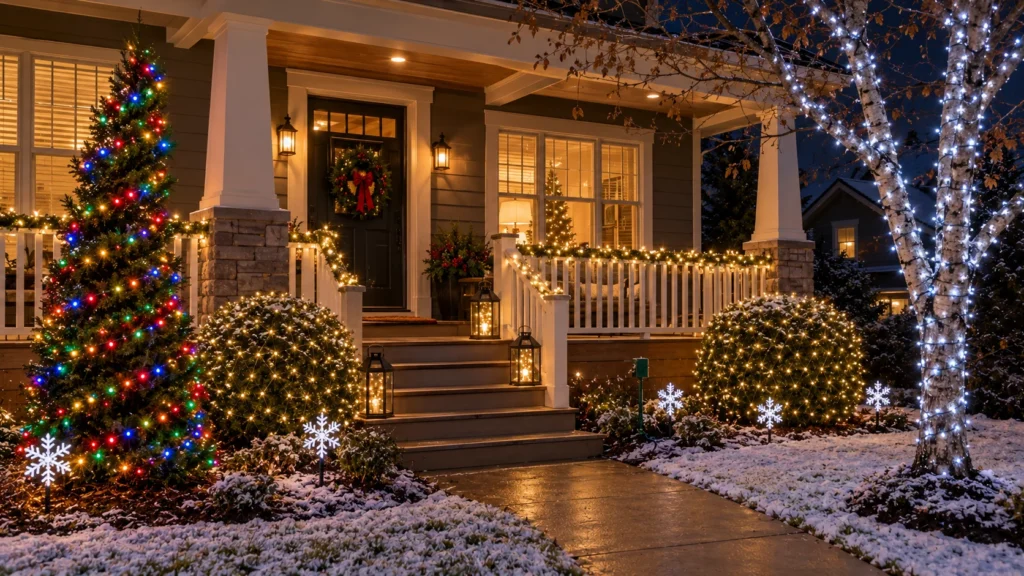
These outdoor Christmas lighting ideas move from the house outward, the same order most professional installers follow. Pick a few that suit your home rather than trying all of them at once.
Decorate Your Roofline with Christmas Lights
The roofline frames the whole house, so it is the best place to start. Use C9 bulbs on 12-inch spacing for a bold, classic look that reads from the street. Trace the gutters first, then add peaks and gables if you want more drama. Straight, evenly spaced bulbs are the hallmark of a professional job.
Wrap Trees and Branches with String Lights
Wrapped trees look magical, especially deciduous trees with bare winter branches. Start at the base and spiral mini lights up the trunk, keeping each loop about 3 to 6 inches apart. Then work out along the main limbs. Tighter spacing looks richer but needs more lights, so wrap one tree beautifully rather than three trees thinly.
Illuminate Your Front Porch and Entryway
Frame the front door with pre-lit garland and add a lit wreath at eye level. Outline porch railings and columns with string lights, and place battery operated Christmas lights inside lanterns on the steps. The entry is where guests look closest, so it deserves the most detail.
Add Christmas Lights to Bushes and Hedges
Net lights cover bushes in minutes and look tidy. For round shrubs, a single net draped over the top often works. For long hedges, lay several nets side by side and connect them. Pick one color for all shrubs so the yard looks unified.
Create a Magical Walkway with Light Stakes
Line your front walk with C9 bulbs on low stakes, lighted candy canes, or star stakes. Space them evenly, often 1 to 2 feet apart, and keep them at the same height for a clean line. Lighted paths look beautiful and help guests see where they are walking.
Decorate Windows with Christmas Lights
Outline windows with mini lights using adhesive clips, or hang a battery operated wreath in each one. For a cozy look, hang lighted curtain lights inside the window facing out. Matching treatments across every front window make the house look finished.
Light Up Your Garden and Landscape
Spotlights aimed at evergreens, stone walls, or the front of the house add depth. Uplighting a large tree with a green or warm white floodlight is an easy way to make the whole yard feel bigger. Solar lights fit nicely in garden beds that get daytime sun.
Add Festive Lights to Your Patio and Backyard
Do not forget the spaces you use. String globe or bistro-style lights over a patio or pergola, wrap a pergola post with garland and lights, or light up a fire pit area for winter gatherings. These lights can often stay up well past the holidays.
Create a Stunning Christmas Light Display with C9 Bulbs
C9 bulbs are not only for rooflines. Wrap them around large evergreens for a vintage look, outline driveways, or spell simple shapes on a fence. Using the same bulb type on the roof, path, and trees creates a cohesive display that looks planned.
Highlight Your Home with Outdoor Light Decorations
Finish with one or two focal pieces, like lighted reindeer, a large lit star on the garage, or a lighted arch over the walkway. Pair these outdoor Christmas decorations with your main light color so they blend with the rest of the display.
How to Choose the Best Outdoor Christmas Lights
The best outdoor Christmas lights for your home depend on your house, your climate, and how much time you want to spend. These six checks make the choice simple.
Consider LED vs. Traditional Incandescent Lights
LEDs use much less power, last far longer, and stay cool, so they are the better pick for almost every outdoor use. Incandescent bulbs still have a classic warm glow and a lower upfront cost, but they burn out faster and cost more to run. If you love the old look, choose warm white LEDs labeled 2700K or “incandescent look.”
Choose the Right Christmas Light Colors
Warm white flatters red brick, wood, stone, and greenery. Cool white looks crisp on white, gray, or blue homes and suits a snowy, modern style. Multicolor feels playful and nostalgic. Whatever you choose, avoid mixing warm white and cool white on the same house, since the difference looks like a mistake from the street.
Check Weather Resistance and Waterproof Ratings
Always buy lights marked for outdoor use. Many waterproof Christmas lights also list an IP rating, an international code for protection against dust and water. The second number is the water rating. IP44 means splash resistant, IP65 means protected from water jets, and IP67 means the product can handle brief submersion. For lights on gutters, in shrubs, or near the ground where snow melts, IP65 or higher is a smart choice.
Select the Right Bulb Size and Brightness
Bigger homes and longer viewing distances call for bigger bulbs. C9s read clearly from across the street, C7s suit porches and smaller homes, and mini lights are best for close-up details like trees and railings. Wide-angle and faceted bulbs scatter light and look brighter than smooth bulbs of the same size.
Compare Solar-Powered and Plug-In Christmas Lights
| Feature | Plug-in | Solar | Battery |
|---|---|---|---|
| Brightness | Brightest and most consistent | Varies with daily sun | Moderate, fades as batteries drain |
| Placement | Needs an outlet or cord route | Needs several hours of direct sun | Anywhere |
| Running cost | Electricity | Free | Batteries |
| Best for | Rooflines, trees, main display | Garden beds, fences | Wreaths, lanterns, mailboxes |
Calculate How Many Christmas Lights You Need
Measure first, then buy. Here are the common rules of thumb.
| Area | How to measure | What to buy |
|---|---|---|
| Roofline and gutters | Measure each run in feet | Feet of roofline plus about 10%, plus the distance to the outlet |
| Trees, wrapped | Height times the number of main limbs you plan to wrap | Roughly 100 mini lights per foot of trunk and branch for a rich look |
| Bushes | Height and width of each shrub | Enough net lights to cover the top and visible sides |
| Walkways | Length of the path | One stake every 1 to 2 feet on each side |
| Windows and doors | Perimeter of each opening | Perimeter plus a little extra for corners |
For example, a ranch house with 60 feet of front gutter needs about 66 feet of C9 lights, plus enough extension or lead cord to reach the nearest outdoor outlet.
How to Hang Outdoor Christmas Lights
Hanging lights is mostly planning and hardware. Get those right, and the climbing part goes quickly. Here is the order that works for most homes.
Plan Your Outdoor Lighting Design
Stand across the street and take a photo of your house. Mark where you want lights, then mark every outdoor outlet. Plan cord routes so they stay off walkways and out of puddles. Decide where the display will be plugged in and how you will control it, such as a mechanical timer, a smart plug rated for outdoor use, or a photocell that turns lights on at dusk.
Measure Rooflines, Trees, and Other Areas
Use a long tape measure or a measuring wheel from the ground. Write down each roofline run, each peak, and the distance from the end of each run to its outlet. Add about 10% for corners and mistakes. Measuring from the ground saves extra trips up the ladder.
Use Christmas Light Clips and Hooks
Christmas light clips are the secret to straight, secure lines. They hold lights firmly without damaging your home, unlike nails or staples, which can pierce wire insulation.
| Clip type | Where it goes | Good for |
|---|---|---|
| All-in-one gutter and shingle clips | Hooks onto the gutter lip or slides under shingles | Most rooflines with C9, C7, or mini lights |
| Ridge clips | Clips to ridge caps | Lights along the roof peak |
| Parapet clips | Grip flat roof edges and walls | Flat roofs and stucco edges |
| Adhesive clips | Stick to clean, smooth surfaces | Windows, doors, brick, and siding |
| Light stakes | Push into the ground | Walkways and garden beds |
Place one clip at every bulb or every 12 inches for C9 lights. Clipping the bulb base so all bulbs point the same direction, usually straight up, gives the cleanest look.
Install Lights Along Rooflines and Gutters
- Attach clips on the ground first. Snap clips onto each bulb or socket while the strand is laid out on the lawn. This saves time on the ladder.
- Start at the outlet end. Begin closest to your power source so the plug end lands where you need it.
- Work in short sections. Clip a few feet at a time, then move the ladder rather than reaching. Keep your belt buckle between the ladder rails.
- Keep it straight and tight. Pull slight tension on the strand as you go so it does not sag between clips.
- Finish the end neatly. Tuck extra wire behind the gutter and avoid leaving loose loops that wind can catch.
Wrap Trees and Outdoor Structures Safely
For small trees, a light pole or extension pole helps you wrap high branches from the ground. Start where the plug can reach an outlet, spiral up the trunk, then work out along each limb and back. Avoid wrapping lights so tightly that they cut into bark, and never wrap lights around anything near power lines.
Test Your Lights Before Installation
Plug in every strand on the ground before you climb. Replace dead bulbs and toss strands with cracked sockets or frayed wire. A light tester tool can find a bad bulb on a mini light strand much faster than checking each one by hand. Testing first means you will never take down a whole roofline to fix one dark section.
Taking lights down
When the season ends, unclip lights rather than pulling them. The CPSC warns that tugging on lights can stress the connections and create a fire hazard. Wrap strands around a cord reel or cardboard, label them by location, and store clips in a separate bin for next year.
Outdoor Christmas Lighting Safety Tips
Outdoor holiday lighting combines electricity, water, ladders, and cold weather, so a few rules matter a lot. The U.S. Consumer Product Safety Commission estimates about 160 decorating-related injuries a day during the holiday season, and almost half involve falls, as AARP reports from CPSC data.
Use Lights Rated for Outdoor Use
Check the box and the tag on the cord. Outdoor lights should say they are for outdoor use and carry a mark from a recognized testing lab such as UL, ETL, or CSA. Holiday light strings sold in the US are typically tested to the UL 588 standard.
Protect Electrical Connections from Moisture
Plug outdoor lights into GFCI-protected outlets, which cut power quickly if water causes a fault. If your outdoor outlets are not GFCI protected, use a portable outdoor GFCI. Keep plug connections off the ground with stakes, and use weatherproof connection covers or outlet covers rated for use while plugged in.
Avoid Overloading Electrical Circuits
Most household circuits are 15 amps, which equals about 1,800 watts at 120 volts. Electricians commonly advise keeping continuous loads at around 80% of that, or about 1,440 watts. Older CPSC guidance suggests no more than three standard incandescent sets per extension cord. LEDs draw far less, so you can connect more, but always follow the maximum listed on the light’s tag.
Use Outdoor-Rated Extension Cords
Choose cords labeled for outdoor use, often marked with a W on the jacket. For long runs or heavier loads, a thicker 14 or 12 gauge cord is better than a thin 16 gauge cord. Never run cords through doorways or windows where they can be pinched, and do not cover them with rugs.
Follow Ladder and Roof Safety Guidelines
- Set the ladder on firm, level ground and follow the 4-to-1 rule, one foot out from the wall for every four feet of height.
- Keep three points of contact and never stand on the top rungs.
- Have a helper hold the ladder and hand up lights.
- Stay well away from overhead power lines. Many utilities advise keeping yourself and your ladder at least 10 feet away.
- Skip the roof when it is wet, icy, windy, or getting dark. For steep or two-story roofs, consider hiring a professional installer.
Check Local Rules and HOA Guidelines
Some HOAs and towns limit display dates, brightness, or hours, and some restrict roof-mounted items. Being a good neighbor helps too. Put lights on a timer that turns them off at a reasonable hour, such as 10 or 11 p.m., and avoid aiming bright spotlights into neighbors’ windows. DarkSky International shares tips on reducing light pollution if you live near open land or wildlife areas.
The Electrical Safety Foundation International also publishes free seasonal safety checklists that are worth a quick read before you start.
Benefits of LED Outdoor Christmas Lights
If you still have boxes of old incandescent strands, here is why switching is worth it.
Lower Energy Consumption
The U.S. Department of Energy notes that LEDs use far less electricity than incandescent bulbs, often up to 75% less. You can estimate your own cost with a simple formula.
Watts ÷ 1,000 × hours per night × nights × price per kWh = season cost
A Cornell Cooperative Extension fact sheet lists 125 incandescent C7 bulbs at about 750 watts. Running them 6 hours a night for 40 nights uses 180 kWh. At the U.S. Energy Information Administration’s forecast average of about 18 cents per kWh for 2026, that is roughly $32 for one season. An LED set using about 75% less energy would cost around $8. Multiply that across a full roofline, trees, and shrubs, and the savings add up fast.
Longer Lifespan and Durability
LED bulbs last many times longer than incandescent mini lights, and their plastic lenses do not shatter when dropped or hit by hail. Many commercial LED sets are sealed so bulbs cannot loosen or let in water, which means fewer dark sections mid-season.
Reduced Heat Production
Incandescent bulbs turn much of their energy into heat. LEDs stay cool to the touch, which is safer around dry leaves, fabric bows, and kids’ hands, and easier on plastic gutters and siding.
More Color and Lighting Options
LEDs come in nearly every color, from warm and cool whites to deep reds and blues. They also make possible twinkle, fade, and chasing effects, as well as RGB smart lights you can change from your phone. Because each strand draws so little power, you can connect many more strands end to end, following the limit on the tag.
Frequently Asked Questions About Outdoor Christmas Lights
What are the best Christmas lights for outdoor use?
LED lights labeled for outdoor use with a UL, ETL, or CSA mark are the best choice for most homes. Use C9 bulbs for rooflines, mini string lights for trees, net lights for bushes, and battery operated lights for spots with no outlet.
Can Christmas lights stay outside all winter?
Outdoor-rated lights can stay up through the season, and many people leave roofline lights up until late January. Leaving holiday strings up year-round shortens their life, since sun, ice, and wind wear down wires and sockets. If you want lights up all year, consider a permanent track lighting system built for it.
How do I hang Christmas lights on a rooftop?
Measure from the ground, test every strand, and attach Christmas light clips to the bulbs while the strand is on the lawn. Then start at the outlet end and clip lights to the gutter or shingles in short sections, moving the ladder as you go. For steep or high roofs, hire a pro.
How many outdoor Christmas lights do I need for my yard?
Measure each roofline, window, and path, then add about 10%. For trees, plan roughly 100 mini lights per foot of trunk and branches you wrap. For bushes, buy enough net lights to cover the top and visible sides.
What color Christmas lights look best outdoors?
Warm white suits most homes, especially brick, stone, and wood. Cool white looks crisp on white or gray siding. Multicolor lights feel festive and nostalgic. Keep one white tone across the whole house.
Are LED outdoor Christmas lights better than traditional lights?
Yes, for most people. LEDs use much less electricity, last longer, stay cool, and resist breaking. Incandescent lights cost less upfront but more to run.
Can I leave outdoor Christmas lights on overnight?
Safety groups recommend turning lights off when you go to bed or leave home. A timer or smart plug makes this automatic and saves energy.
How do I keep outdoor Christmas lights from falling down?
Use the right Christmas light clips for each surface, place one clip every bulb or every 12 inches, and pull the strand snug as you go. Adhesive clips need a clean, dry surface and stick best when applied on a mild day, so check the package for the minimum temperature.
Are solar Christmas lights good for outdoor decorations?
They are good for garden beds and fences that get several hours of direct sun. On short, cloudy winter days they may be dim or shut off early, so use them as accents rather than for the main display.
Can indoor Christmas lights be used outdoors?
No. Indoor lights are not built to handle rain, snow, or temperature swings, and using them outside raises the risk of shock and fire. Always check the label for outdoor use.
Plan Once, Enjoy It for Years
Great outdoor lighting is less about how many strands you buy and more about choosing the right light for each spot. Start with a clean roofline of C9 bulbs, add one beautifully wrapped tree, light the path to your door, and fill the gaps with battery lights where cords cannot reach.
Measure before you shop, test before you climb, and use proper clips and outdoor-rated cords. Do that, and your outdoor Christmas lights will go up faster, stay straighter, and come back brighter every December.
4 Comments