
Chifferobe Guide to This Charming, Classic Wardrobe
Maybe you first heard the word in English class, reading To Kill a Mockingbird. Maybe your grandmother had one in the spare bedroom. Or maybe you spotted the term on a furniture site and wondered why anyone still uses it. This guide explains what a chifferobe is, where it came from, and how to buy and care for one today.
A chifferobe is a wonderfully practical piece of furniture. It is a freestanding closet and a dresser in one, built for homes that did not have enough closet space. More than a century after it first showed up in a Sears catalog, it still solves the same problem in small bedrooms, apartments, and older houses.
This guide explains exactly what a chifferobe is, how to say and spell it, what a chiffonier is, how they compare with armoires and wardrobes, how to tell a valuable antique from a reproduction, and how to choose, place, and care for one today.
What Is a Chifferobe?
A chifferobe is a tall, freestanding piece of furniture that combines a wardrobe for hanging clothes with a chest of drawers for folded items. Most designs put a tall cabinet with a hanging rod on one side and a stack of drawers on the other, often with a small cabinet or hat compartment above the drawers.
The name is a blend of two older furniture words, “chiffonier” and “wardrobe.” Linguists call this kind of mashup a portmanteau.
Spelling it right
You will see several spellings, and all of them refer to the same piece.
- Chifforobe is the spelling most dictionaries list first.
- Chifferobe is very common in furniture stores and online listings, especially among Amish furniture makers.
- Chiffarobe is the spelling Harper Lee used in To Kill a Mockingbird.
Because shoppers search all three, many stores use more than one spelling on the same page.
How to pronounce chifferobe
Say it SHIF-uh-rohb. The “ch” sounds like “sh,” as in the French word chiffon, and the ending rhymes with “robe.” The Wikipedia entry gives the same pronunciation.
A uniquely American piece
According to the Oxford English Dictionary, as summarized by Grammarphobia, the word originated in the United States. It has long been most common in the American South, where people sometimes use it loosely for any tall wardrobe, even one without drawers.
What Is a Chiffonier?
To understand the chifferobe, it helps to know its parent. A chiffonier is a piece of storage furniture, but what it looks like depends on which side of the Atlantic you are on.
The American meaning
In the United States, a chiffonier is a tall, narrow chest of drawers, often with a flat top and sometimes with a mirror attached. Merriam-Webster defines it simply as a high, narrow chest of drawers. Think of it as a slim, vertical dresser that takes up less floor space than a wide one.
The British meaning
In Britain, the word usually means something quite different. The Oxford English Dictionary describes a chiffonier as a small cupboard with a top that works as a sideboard, the kind of low cabinet you might find in a Regency or Victorian dining room. The OED dates this furniture sense in English to 1806.
Where the word comes from
The name comes from the French chiffon, meaning a scrap of cloth or rag. A chiffonnier in French was originally a ragpicker, and the furniture name came to suggest a place for keeping odds and ends. The OED notes it was sometimes spelled “sheffonier,” which reflects how people actually pronounced it.
| Term | US meaning | UK meaning |
|---|---|---|
| Chiffonier | Tall, narrow chest of drawers | Low cabinet or small sideboard with doors |
| Chifferobe | Wardrobe plus chest of drawers | Rarely used |
So when an American calls a piece a chifferobe, they mean the drawers of a chiffonier joined to the hanging space of a wardrobe.
A Short History of the Chifferobe
Born in the mail-order catalog
The earliest well-documented use of the word comes from the 1908 Sears, Roebuck and Co. catalog, which introduced chifforobes as “a modern invention, having been in use only a short time,” according to OED citations shared by Grammarphobia. The online etymology dictionary Etymonline dates the word slightly earlier, to 1903.
The timing made sense. Many American homes of the late 1800s and early 1900s had few or very small built-in closets. Mail-order catalogs from Sears and Montgomery Ward put affordable, factory-made furniture within reach of families across rural America. A single piece that could hold both hanging and folded clothes was a practical, budget-friendly answer.
Popular in the South
Chifferobes became especially common in Southern homes and stayed in everyday speech there long after built-in closets became standard elsewhere. That regional connection is part of why the word still sounds a little old-fashioned and homey to many Americans.
Famous in American literature
Many Americans know the word from Harper Lee’s 1960 novel To Kill a Mockingbird. The spelling “chiffarobe” appears in the book, and it plays a key role in the trial. Mayella Ewell testifies that she asked Tom Robinson onto her family’s property to break up an old chiffarobe for kindling, and that errand becomes central to the case against him.
The word also turns up in Alice Walker’s The Color Purple and in other Southern fiction, which helped keep it alive for readers who had never seen one in person.
From necessity to choice
As closets became a standard feature of new American homes in the mid-1900s, chifferobes shifted from must-have to charming extra. Today, they are popular again with people who live in older homes, small apartments, and rentals with tight closets, and with anyone who loves antique furniture. Many midcentury homes, like the classic ranch style house, were built with small closets, which is one reason a chifferobe still earns its place in a bedroom.
Chifferobe vs. Armoire vs. Wardrobe vs. Chiffonier vs. Dresser
These pieces overlap a lot, and stores do not always use the names consistently. Here is how they usually differ.
| Piece | Hanging space | Drawers | Typical shape | Origin |
|---|---|---|---|---|
| Chifferobe | Yes, on one side | Yes, stacked on the other side | Tall and wide, often asymmetrical | American, early 1900s |
| Wardrobe | Yes, usually the full width | Sometimes one or two at the bottom | Tall cabinet with one or two doors | English and European |
| Armoire | Often, or shelves | Sometimes at the bottom | Tall, ornate cabinet, often with carved doors | French |
| Chiffonier, US | No | Yes, many | Tall and narrow | French name, American use |
| Highboy | No | Yes, many, on a raised base | Very tall with legs | English and colonial American |
| Dresser | No | Yes | Wide and waist-high, often with a mirror | Widely used |
Chifferobe vs. armoire
An armoire is a tall, often decorative French cabinet that may hold hanging clothes, shelves, or even a TV. A chifferobe is defined by its split layout, with hanging space and a set of drawers side by side. If the piece has a stack of drawers next to a hanging compartment, it is a chifferobe, whatever the tag says.
Chifferobe vs. wardrobe
A wardrobe is mainly about hanging space, with doors across the full width and maybe a drawer or two at the bottom. A chifferobe gives up some hanging width to add a full column of drawers.
Chifferobe vs. dresser
A dresser stores only folded clothes and is usually waist height. A chifferobe is tall enough to hang shirts and dresses, so it can replace both a dresser and a small closet.
Inside a Chifferobe, Parts and Features
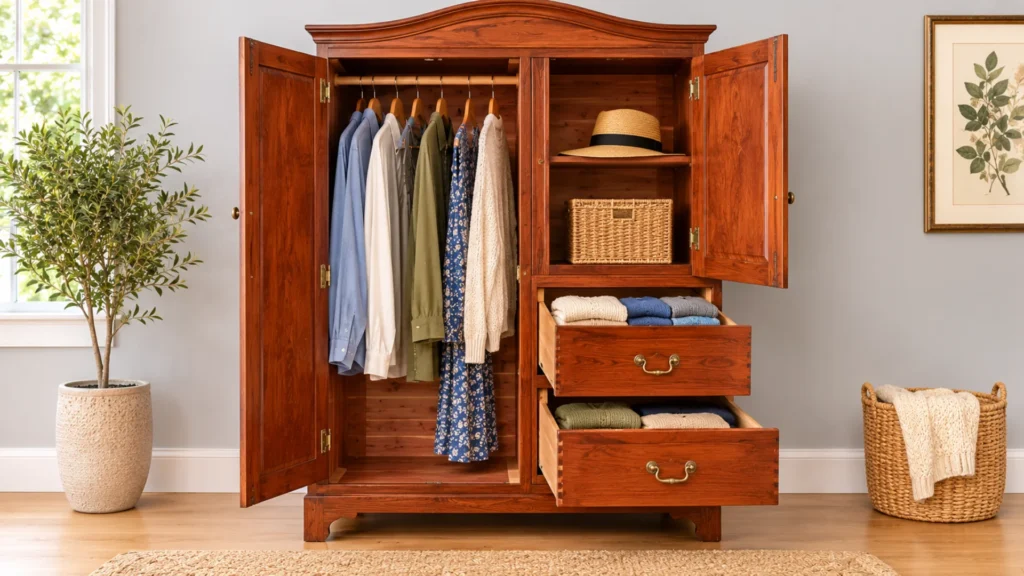
No two chifferobes are exactly alike, but most share a familiar layout.
The wardrobe side
One tall door opens to a compartment with a hanging rod. On antiques, this side is often narrow, around 18 to 24 inches wide, which fits a modest row of shirts, dresses, or coats. Some have a shelf above the rod for hats or folded sweaters, and many older pieces have a mirror set into the outside of the door.
The drawer side
The other side holds a stack of drawers, usually three to five. Some combine small top drawers for socks and jewelry with deeper bottom drawers for sweaters and linens.
The top cabinet or hat box
Many chifferobes have a small cabinet with its own door above the drawers. Sellers often call this the hat box or hat compartment. Today it is handy for accessories, scarves, or a jewelry tray.
Other common features
- Cedar lining. Aromatic cedar helps the wardrobe side smell fresh, and many people use it to help discourage moths.
- Locks and keys. Antique doors and drawers often had small keyhole locks.
- Crown molding or a curved top. A decorative top adds height and style.
- Mirrors. Either inset on the door or mounted on top, so the piece doubles as a dressing area.
- Legs or a plinth base. Short legs lift the piece off the floor, while a solid base adds stability.
Typical sizes
| Measurement | Common range |
|---|---|
| Height | About 60 to 74 inches |
| Width | About 36 to 48 inches |
| Depth | About 18 to 24 inches |
Always check the specific listing, since antiques and modern pieces vary widely.
Popular Chifferobe Styles
The chifferobe has been reinterpreted in nearly every style of American furniture over the past century.
Early 1900s oak
The classic catalog chifferobe was often made of oak, sometimes quarter-sawn to show off a striking grain. Simple lines, brass or wooden pulls, and a mirrored door are typical.
Art Deco and waterfall
In the 1930s and 1940s, many chifferobes took on the rounded “waterfall” look, with curved front edges, bookmatched veneers, and Bakelite or chrome pulls. These pieces are popular with vintage collectors today.
Mid-century
After World War II, some makers built sleeker chifferobes with tapered legs and simpler hardware, though they became less common as closets spread.
Amish and solid wood
Today, many new chifferobes are handmade by Amish craftspeople in Ohio, Indiana, and Pennsylvania from solid oak, cherry, maple, hickory, or elm. You will see Mission, Shaker, and farmhouse versions, often with dovetailed drawers and cedar-lined wardrobe compartments.
Children’s chifferobes
Smaller chifferobes sized for kids’ rooms usually have a lower hanging rod for children’s clothes and fewer drawers. Some include a mirror or a small cubby on top. A kids’ chifferobe painted pink, green, or navy also fits right into preppy room decor.
Modern and budget
Mass-market retailers offer chifferobe-style wardrobes in painted finishes, engineered wood, and veneers. They are affordable and easy to ship, though they are typically less durable than solid wood.
Smart Ways to Use a Chifferobe Today
A chifferobe is not just for bedrooms. Its mix of hanging space and drawers makes it useful all over the house. For more space-saving pieces, see our guide to furniture for small living room layouts.
- Small bedroom without a closet. This is its original job. It can replace both a closet and a dresser in a guest room, studio apartment, or older home.
- Nursery or kids’ room. Hang tiny outfits on one side and store diapers, blankets, and pajamas in the drawers. Choose a piece you can anchor to the wall.
- Entryway coat closet. Hang coats and jackets on the rod, and use drawers for gloves, hats, scarves, and dog leashes.
- Guest room storage. Keep spare bedding, towels, and toiletries ready for visitors.
- Home office. Store printer paper and supplies in the drawers and hide a printer or files in the cabinet.
- Craft or sewing room. Fabric fits on the hanging side, and notions, yarn, and tools fit in the drawers.
- Linen closet. Fold towels and sheets in the drawers and hang tablecloths so they stay wrinkle-free.
- Dining room or pantry overflow. Store table linens, serving pieces, and holiday decor.
A note on very old pieces
Hanging rods on early chifferobes may be set for shorter garments, and some interiors are too shallow for wide modern hangers. Measure the rod height and interior depth before planning to hang long dresses or bulky coats.
How to Choose the Right Chifferobe
Measure your space first
- Floor space. Measure width and depth, and leave room to open the doors fully, usually at least the width of the wardrobe door in front of the piece.
- Ceiling height. Leave a few inches above the top, especially if it has a crown or you plan to store baskets up there.
- Doorways and stairs. Measure every door, hallway, and staircase it must pass through. Antiques often do not come apart, while many new pieces ship in sections.
Check the hanging space
Measure from the rod to the floor of the compartment. Shirts and blouses need roughly 40 inches, while long dresses and coats need closer to 60 inches. Check that standard hangers fit the depth, which needs to be about 20 inches or more for most adult clothes.
Look at the construction
- Solid wood vs. engineered wood. Solid hardwood lasts for generations and can be refinished. Particleboard and MDF cost less but can sag, swell with moisture, and are hard to repair.
- Drawer joints. Dovetail joints are a sign of good craftsmanship. Stapled or glued drawer boxes wear out faster.
- Drawer glides. Wood-on-wood runners suit traditional pieces. Metal ball-bearing glides open more smoothly under heavy loads.
- Back panel. A solid back panel is sturdier than thin hardboard.
Plan for safety
Tall, heavy furniture can tip over, especially if a child climbs open drawers. The U.S. Consumer Product Safety Commission’s Anchor It campaign urges families to secure dressers, wardrobes, and similar furniture to the wall. A federal tip-over standard under the STURDY Act now applies to new clothing storage units sold in the US, but antique and older pieces will not meet it, so anchoring matters even more.
Think about style
Match the wood tone or finish to your other bedroom furniture, or let the chifferobe stand out as a statement piece. Painted chifferobes in soft blues, greens, or white suit farmhouse and cottage rooms. If you love lighter, woven textures, a chifferobe also pairs well with rattan furniture like a cane-back chair or nightstand.
Buying an Antique Chifferobe
Vintage chifferobes turn up regularly at estate sales, antique malls, and online marketplaces. Here is how to judge what you are looking at.
Clues to age
- Dovetail joints. Pull out a drawer and look at the corners. Hand-cut dovetails are slightly uneven and usually fewer and wider. Machine-cut dovetails are perfectly uniform and became common in factory furniture by the late 1800s, so most early 1900s chifferobes have them.
- Saw marks and wood. Look at the back panel and drawer bottoms. Older pieces often show circular or straight saw marks and use solid wood or thick veneers rather than particleboard.
- Hardware. Original pulls, keyhole escutcheons, and hinges suggest the piece has not been heavily altered. Look for extra screw holes that show hardware was replaced.
- Labels and stamps. Check inside drawers and on the back for maker’s labels, catalog numbers, or furniture company stamps.
- Style. Quarter-sawn oak and simple lines suggest the 1900s to 1920s. Waterfall curves and exotic veneers point to the 1930s and 1940s.
Condition checks
- Open and close every door and drawer to check for sticking or broken runners.
- Look for lifting or chipped veneer, water stains, and cracks.
- Smell the inside. A musty odor can usually be fixed, but strong mildew may signal moisture damage.
- Check for small holes and fine powdery dust, which can mean wood-boring insects.
- Make sure the mirror is secure and the silvering is in acceptable shape.
What antique chifferobes are worth
Prices vary with age, wood, maker, condition, and local demand. Many ordinary vintage chifferobes sell for a few hundred dollars, while well-preserved Art Deco waterfall pieces, quarter-sawn oak examples, and pieces by known makers can bring more. Check recently sold listings on sites like eBay, Chairish, or local auction results for comparable pieces before you buy or sell.
Painted pieces and lead
If an old chifferobe has layers of paint, it may contain lead-based paint, which was common in homes before 1978. The EPA recommends testing before sanding or scraping old paint, especially in homes with young children.
Buying a New Chifferobe
If you want the look without the restoration work, there are plenty of new options at every budget.
Amish and handcrafted pieces
Amish furniture makers are a go-to source for new solid wood chifferobes. Retailers such as Countryside Amish Furniture, Amish Furniture Factory, Heartland Amish, Weaver Furniture Sales, and DutchCrafters sell solid wood chifferobes in oak, cherry, maple, hickory, and other woods, often with choices of stain, hardware, and cedar lining. Many are built to order, so expect to wait several weeks to a few months.
Mass-market and online retailers
Larger furniture stores and online marketplaces sell chifferobe-style wardrobes in painted finishes and engineered wood. These are the most affordable and often ship flat-packed. Read reviews for comments on sturdiness and assembly.
Rough price ranges
| Type | Typical price range | What you get |
|---|---|---|
| Budget engineered wood | Under about $400 | Painted or laminate finish, flat-pack assembly |
| Mid-range | About $400 to $1,500 | Solid wood parts with veneers, better hardware |
| Amish or custom solid wood | About $1,500 and up | Solid hardwood, dovetailed drawers, custom finishes, often cedar lining |
| Vintage and antique | Often a few hundred dollars, more for prized styles | Varies with age, wood, and condition |
These are rough ranges from common US listings. Prices shift with size, wood species, and features.
Questions to ask before ordering
- What wood species and finish are used throughout, including the sides and back?
- Are the drawers dovetailed, and what kind of glides do they use?
- How tall is the hanging space, and how deep is the interior?
- Does it ship assembled or in sections?
- Is a wall anchor kit included?
- What is the lead time and return policy for custom orders?
Caring for and Restoring a Chifferobe
Everyday care
- Dust with a soft, dry microfiber cloth.
- Clean spills right away with a barely damp cloth, then dry the surface.
- Keep the piece out of strong direct sun, which can fade wood and dry out finishes.
- Avoid placing it right next to radiators or heating vents.
- Keep indoor humidity reasonably steady so wood does not crack in winter or swell in summer.
Getting rid of musty smells
Old wardrobes often smell stale. Try these steps in order.
- Empty the piece and vacuum the interior and drawers.
- Wipe the inside with a cloth dampened with mild soapy water, then let it dry with the doors open.
- Place an open box of baking soda or a bowl of activated charcoal inside for several days.
- Air it out in a dry, shaded spot if possible.
- If the smell lingers, line drawers with fresh paper or add cedar blocks or sachets.
Stubborn odors may need a sealer made for furniture interiors, applied after the wood is clean and dry.
Refreshing cedar lining
Cedar loses its scent over time as the surface oils dry out. Lightly sanding the cedar with fine sandpaper exposes fresh wood and brings the aroma back. Do not varnish cedar lining, since a finish seals in the scent.
Restoring an antique
- Clean the finish with a gentle wood cleaner before deciding to refinish. Many old finishes just need cleaning and a fresh coat of paste wax.
- Tighten loose hardware and glue loose joints with wood glue.
- Rub a little paraffin or candle wax on sticky wooden drawer runners.
- Think twice before stripping an antique, since original finishes often add to the value.
- For veneer repairs, broken frames, or valuable pieces, consult a professional furniture restorer.
Chifferobe FAQs
What is a chifferobe used for?
A chifferobe stores both hanging and folded clothes in one piece of furniture. It is ideal for bedrooms with small closets or none at all, and it also works well as an entryway coat closet, linen storage, or craft cabinet.
How do you pronounce chifferobe?
Say SHIF-uh-rohb. The “ch” sounds like “sh,” and the end rhymes with “robe.”
Is it chifforobe or chifferobe?
Both are correct and refer to the same piece. Chifforobe is the dictionary-preferred spelling, chifferobe is common with furniture sellers, and chiffarobe is the spelling used in To Kill a Mockingbird.
What is the difference between a chifferobe and a chiffonier?
In the US, a chiffonier is a tall, narrow chest of drawers with no hanging space. A chifferobe adds a wardrobe compartment with a hanging rod next to the drawers.
What is the difference between a chifferobe and an armoire?
An armoire is a tall French-style cabinet that may hold clothes, shelves, or electronics. A chifferobe specifically pairs a hanging section with a column of drawers, usually side by side.
Why is a chifferobe mentioned in To Kill a Mockingbird?
In the novel, Mayella Ewell says she asked Tom Robinson to break up an old chiffarobe, and that errand becomes a key part of the trial. The word reflects the everyday furniture of the rural 1930s South where the story is set.
Are antique chifferobes valuable?
Some are. Value depends on age, wood, maker, condition, and style. Many sell for a few hundred dollars, while rare or especially well-preserved pieces can bring more.
How do I keep a chifferobe from tipping over?
Use an anti-tip kit to anchor it to a wall stud, keep heavier items in the bottom drawers, and never let children climb on open drawers or doors.
A Century-Old Solution That Still Makes Sense
The chifferobe was born in a Sears catalog as a fix for homes without closets, and it still does that job beautifully. It gives you hanging space and drawers in one footprint, adds character to a room, and connects your home to a piece of American history and literature.
Measure carefully, look for solid construction and dovetailed drawers, anchor it to the wall, and you will have a piece that can serve your family for decades. A quarter-sawn oak antique and a new Amish-built cherry chifferobe have the same thing in common. Both were designed to work hard and last.
2 Comments